


1.
A friend gave me Wendell and Tanya Berry’s mailing address last week. I have been noodling around on a new nonfiction project inspired by Wendell’s poem, “How to Be a Poet (to remind myself)”. That project was beginning to take shape and it was time to formally write Wendell and Tanya to ask for permission to explore it further.1
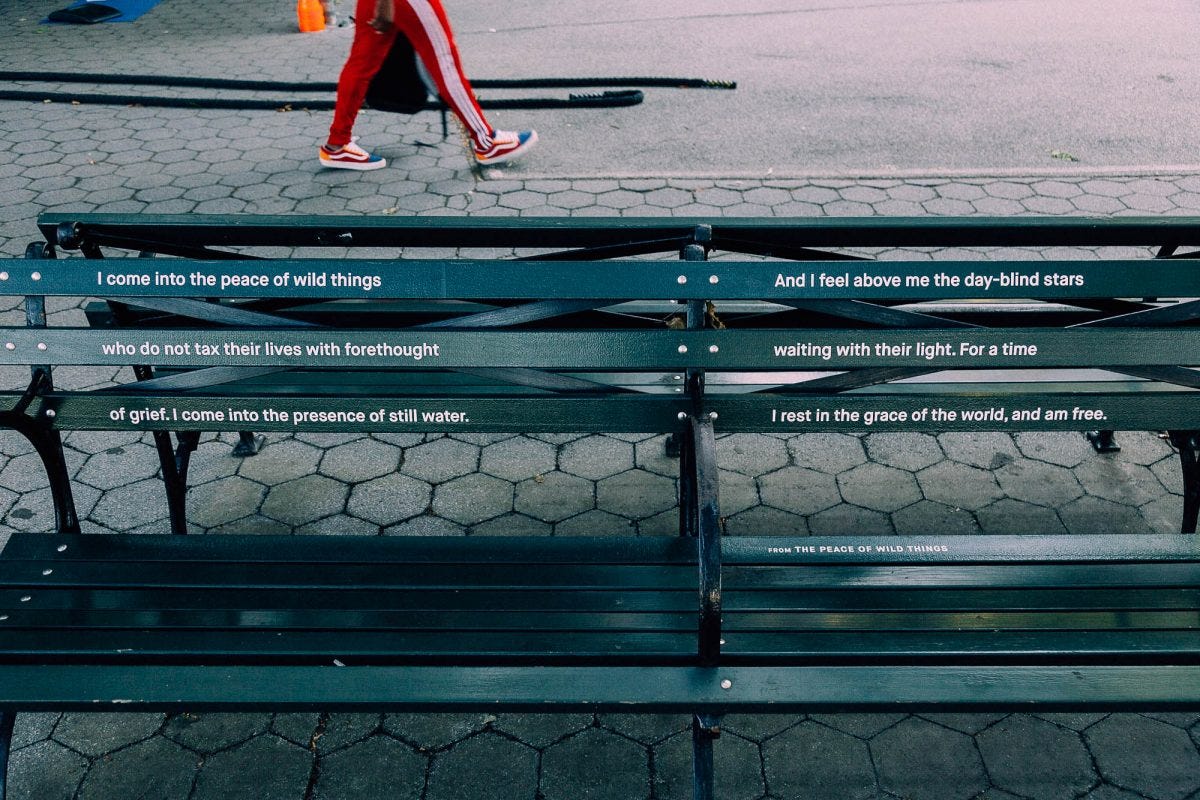
In “How to Be a Poet (to remind myself),” Wendell does just what the title says—gives himself advice on how to be a poet. But this isn’t a listicle on the “7 Steps to Becoming a Professional Poet.” Here is the poem in full:
How to Be a Poet
by Wendell Berry
(to remind myself)
i
Make a place to sit down.
Sit down. Be quiet.
You must depend upon
affection, reading, knowledge,
skill—more of each
than you have—inspiration,
work, growing older, patience,
for patience joins time
to eternity. Any readers
who like your poems,
doubt their judgment.
ii
Breathe with unconditional breath
the unconditioned air.
Shun electric wire.
Communicate slowly. Live
a three-dimensioned life;
stay away from screens.
Stay away from anything
that obscures the place it is in.
There are no unsacred places;
there are only sacred places
and desecrated places.
iii
Accept what comes from silence.
Make the best you can of it.
Of the little words that come
out of the silence, like prayers
prayed back to the one who prays,
make a poem that does not disturb
the silence from which it came.
2.
I remember where I was when I first read this. It was July 2016, I was in North Carolina with my Slow Church co-author Chris Smith. We had just done a talk together and now we were back at our hotel. “How to Be a Poet” was the last thing I read before bed. I must have still been contemplating it in my sleep, because I woke up in the middle of the night, grabbed the closest notebook and pencil, and wrote: “How to Be a POEM.”
It had occurred to me, if subconsciously, that all the advice Berry was giving himself on how to be a poet—make a space, be quiet, depend, stay away from screens, and so on—was also just great advice on how to be more human, especially in an increasingly digital age.
The connection for me was that word POEM. In his letter to the Ephesians, St. Paul wrote, “For we are God’s poiēma, created in Christ Jesus to do good works, which God prepared in advance for us to do.” The Greek poiēma is often translated into English as workmanship or handiwork or masterpiece. It is also the word from which we derive our own word “poem.” So we are both poets and poems; makers, yet made. We create only as creatures. I’m convinced that much of what made Berry such a transcendent writer was that he respected his creatureliness.
For his part, Berry seemed to altogether dismiss the label of “creator.” His 1990 book What Are People For? opens with two essays, “Damaging” and “Healing.” In the latter, he wrote:
The task of healing is to respect oneself as a creature, no more and no less.
A creature is not a creator, and cannot be. There is only one Creation, and we are its members.
To be creative is only to have health: to keep oneself fully alive in the Creation, to keep the Creation fully alive in oneself, to see the Creation anew, to welcome one’s part in it anew.
The most creative works are all strategies of this health.
I do wonder what Berry thought of J.R.R. Tolkien’s language of “sub-creation,” the idea that humans can only make—and, made in the image of the Maker, perhaps can’t help making—secondary creations from God’s primary one. Tolkien wrote, “We make still by the law in which we’re made.”2 Thus, our creative efforts can be acts of worship. Of course they can also be a corruption. They can contribute to the health of Creation or its damage. They can obscure our places or help reveal them. There are no unsacred places, Berry said, only sacred places and desecrated places. Properly subordinated (sub-ordained?) to the Creator, maybe what we make—whether that’s a poem or short story, a song, a painting, a garden, or a household—can participate in the re-sacralization of our places.
Ever since that night in the North Carolina hotel room, I’ve wanted to explore these ideas further. I started a notebook called “How to Be a Poem,” where I would occasionally jot down an idea, a few sentences, or a relevant quote. Mostly the project stayed on the back-burner though, not a top priority but never out of sight.
It was only this February that I began working on it with purpose. I wanted to write a book, but I also needed the book to write me. I had ceded too much territory to what Paul Kingsnorth calls The Machine. The Machine is hard to define but everywhere around us. It is the ominous and increasingly omnipresent techno-cultural something that wants to shape us in its image; whatever it is, it does not have in mind the good of humanity and the rest of Creation. Kingsnorth wrote a book called Against the Machine which opens with an epigraph from Berry: “It is easy for me to imagine that the next great division of the world will be between people who wish to live as creatures and people who wish to live as machines.”
I choose “creature,” God’s poiēma. I want to live a “three-dimensioned life.” Writing the book—living the book—would be my act of resistance. I wanted to call it How to Be a Poem, which meant I needed to write Wendell and Tanya to ask for permission. A friend of mine who has corresponded with the Berrys gave me their address.
Even if I had mailed my letter that day, it would not have arrived in time. Wendell passed away on Monday at the age of 92.
3.
I cohost a podcast about Wendell Berry called The Membership, and so people have been sending me obituaries. I confess I haven’t read beyond the headlines. I did notice that only two—The Guardian (U.K.) and the Kentucky Lantern—described Berry as a farmer. Mostly he was a “writer” and an “environmental activist.” The New York Times called Berry a “Writer Who Extolled America’s Agrarian Past,” which makes him sound like a nostalgist. I’m currently reading the 50th anniversary edition of The Unsettling of America, and it is evident that few people have written with such clarity and prophetic foresight about the present and future of American culture. The great tragedy of that book, Berry said, is that it is as relevant today as it was in 1976.
In its obituary, The Associated Press described Berry as an advocate for a “simpler life.” This doesn’t feel right either. Sure, he famously said, “Don’t own so much clutter that you will be relieved to see your house catch fire.” But I would quibble and say his focus wasn’t so much on simplicity as it was sufficiency. Or enough-ness. Simplicity, properly understood, is a powerful discipline. But it is not well understood, I guess, because my dictionary defines simplicity only as the quality or condition of “being easy to understand or do” or “being plain or uncomplicated in form or design.” (One of the dictionary illustrations is “the simplicities of pastoral living.”) Simplicity is uncomplicated. Sufficiency is complex. Simplicity is a slogan, while sufficiency is a lifelong conversation: What do we need? What do we have? What isn’t here that should be? What is here that shouldn’t?
Sufficiency is an art. Berry wrote about the art of “enough” in his 1989 book The Hidden Wound:
As Thoreau so well knew, and so painstakingly tried to show us, what a man most needs is not a knowledge of how to get more, but a knowledge of the most he can do without, and of how to get along without it. The essential cultural discrimination is not between having and not having or haves and have-nots, but between the superfluous and the indispensable. Wisdom, it seems to me, is always poised upon the knowledge of minimums; it might be thought to be the art of minimums.
I should be more generous to the obituarists. How do you write a thousand words about 92 years and more than 50 books? I know I’m not getting Berry exactly right either. He was, after all, just a man and therefore prone—one assumes—to some contradictions. Certainly his thinking on some topics seemed to evolve over the decades. My favorite thing about “How to Be a Poet (to remind myself)” is that even Wendell Berry (!) needed to be reminded. Get back to the basics, back to the sources. To be renewed, maybe even re-minded.
4.
News of Wendell’s death hit me hard. Substack was flooded with appreciations, but all I could do was walk and write.
I was also dealing with not a little regret. I regret never writing to him, not even to say thank you for what his work has meant to my family and me. I couldn’t find the words. I also regret never meeting him, because I had the chance but didn’t take it. He and I were speaking at the same conference in Louisville and one of the organizers offered to introduce me. But I was too nervous. I regret that. Whoever said “Don’t meet your heroes” needed better heroes. Friends, meet your heroes, if you can, while you can.
Yet my regrets are dwarfed by my gratitudes. No other writer has so profoundly changed my understanding of the world and my place in it. Only C.S. Lewis comes close, and what Lewis once said of his hero George MacDonald, I must say of Berry: “I have never concealed the fact that I regard him as my master, and I fancy I have never written a book”—or article, or speech, or YouTube video—“in which I did not quote from him.” What has been fascinating in recent years has been to read Berry, Lewis, and MacDonald together, putting them into conversation with one another across the centuries. Lewis summed up one stream of MacDonald’s theology this way: “He who loves, sees.” The same could be said of Berry’s theology, and indeed Lewis’s, and I hope my own.
I will only ever know Berry through his writing, yet everything I’ve heard is that Wendell the husband, father, grandfather, neighbor, and friend was the same “Wendell Berry” on the dust jackets of the novels and short stories, essays, and poems. Such was his integrity. I can think of no better testimony than that the people who knew him best respected him most. This week, I watched an interview Wendell’s daughter Mary Berry, the founder and executive director of The Berry Center, gave to a TV station in Louisville. The title of the video was “Daughter of Wendell Berry reflects on his character.” She remembered her father this way: “He was a completely lovely man. He was gentlemanly. He was kind. He was unfailingly gentlemanly and kind.” Yes, there was sometimes an impression of her father as “cranky,” but his family and closest friends knew better. He was very funny, a man of humor.
Mary Berry also described her father as a “man of hope.”3 I remember a 2013 interview in which Bill Moyers asked Wendell Berry what it was that kept him from becoming fatally pessimistic. Berry explained that in his work, and especially his essays, he was always trying to lay out the grounds for a “legitimate, authentic hope.” He said that “if you can find one good example then you’ve got grounds for hope. If you can change yourself, if you can make certain requirements of yourself that you are able to fulfill, you have a reason for hope.”
Even for those of us who will only ever know him through his books, Wendell Berry was a “good example.” Through his words, and in the poem of his life, he gave us grounds for hope. Though he is now gone, hope did not die with him.
This week I looked around and saw everywhere the fruit of the good seeds Berry has been sowing. I thought of the ongoing work of The Berry Center in Henry County, Kentucky, and of The Land Institute, near where I grew up in Salina, which is developing a perennial agriculture that mimics the native tallgrass prairies. I thought of the faithful artists, writers, and musicians who are part of The Rabbit Room community, many of whom honor Berry as a hero. And of my friends and former colleagues at Strong Towns who are using Berry’s ideas to help build stronger, more resilient towns and cities. And I remembered the thousands of Christians I have met through Slow Church and the Parish Collective who look to Berry for inspiration and wisdom as they work for the renewal of their neighborhoods.
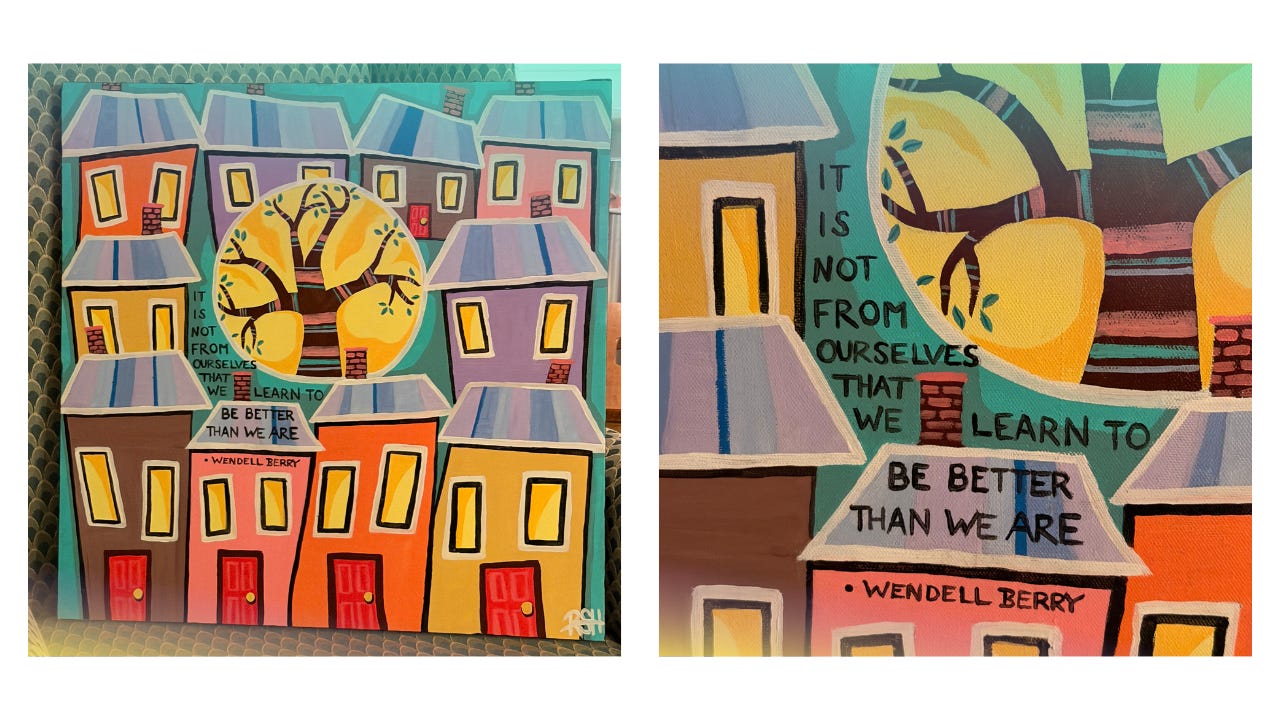
Closer to home, I find a good example in my best friend’s family, who have slowly transformed their suburban lawn into a thriving habitat for pollinators, birds, and other wildlife. I find grounds for hope in the bushel of tomatoes and peppers my wife brought in from our own garden on Thursday. (I find hope for the world, sure, but also hope for fresh salsa.) Then the next day, three neighbors came over to our place to harvest the surplus fruits, vegetables, melons, and pears we won’t be able to use. These are some of the same neighbors who feed their food scraps to our chickens, share their compost with us, host neighborhood movie nights, and watch over our youngest daughter like she is an honorary grandkid. This painting by my friend Bob Henry will soon hang in their community building:
Friends, there are abundant grounds for hope.
Wendell Berry humbly joined into work he did not begin and would not live to see the end of. It is work measured in centuries, not human lifetimes. Then, through word and deed, he invited us all to join him. And I’m grateful. We are his sequoias.
Thank you, Wendell.
Postscript
Four days before Wendell Berry died, I met with my friend Matt Wheeler to discuss re-launching The Membership podcast. In that podcast, we discuss Berry’s writings and we interview people from all walks of life who are putting Berry’s ideas into practice. We have been able to interview Mary Berry, the Amish farmer David Kline, writer Allen Levi, music producer Charlie Peacock, and filmmaker Laura Dunn, among others. Matt and I met again this week after Berry’s passing. We agreed that The Membership feels more important than ever. We will be re-launching this fall with a more sustainable format. The first books we will be discussing is Berry’s forthcoming essay collection, Dispatches from Rural America, as well as the novel Marce Catlett, which comes out in paperback October 6. We will also be interviewing other people who have been inspired by Wendell and Tanya Berry. There are so many “good examples” we can’t wait to introduce to you.
I was looking forward to writing both Mr. and Mrs. Berry. Someone told me a few years ago that Wendell was eager to have Tanya recognized as his co-laborer; his may have been the more public work, but she had been his partner in every way. I have my own version of this. After Slow Church came out I was introduced at a conference as a "thought leader.” I snorted out loud. (God preserve me from ever becoming a “thought leader.”) When I got on stage I made it clear that, if there is a “thought leader” in my house, it isn’t me. My wife Kate has had to drag me into nearly all the best things in our life. Then I write a book about them. Though she couldn’t care less about credit, it is my joy to praise Kate in public for her major contributions to my modest work.
I love this passage from Tolkien’s great poem, ”Mythopoeia”:
Man, Sub-creator, the refracted light
through whom is splintered from a single White
to many hues, and endlessly combined
in living shapes that move from mind to mind.
Though all the crannies of the world we filled
with Elves and Goblins, though we dared to build
Gods and their houses out of dark and light,
and sowed the seed of dragons, ’twas our right
(used or misused). The right has not decayed.
We make still by the law in which we’re made.
Mary Berry on her father: “He said the things we needed to hear and he said some things we all ought to live by. And one is that it’ll never be so bad that we can’t do the right thing that’s right in front of us to do.”
Thanks for these thoughts, John. And thanks to you & Matt for not giving up on The Membership.
Thank you for this perfectly balanced appreciation of what Berry was and is and what he meant and means for you. I think this quotation most resonates throughout: “He who loves, sees." That's the heart of it all, isn't it? And I can see in your work not only that you love but that you love others through your writing and work and hope we, too, see. So, just a heartfelt thank you for this and your work. It's what the world needs as you know as well as any.